
ContractsIQ: the notice clause that decides the claim, FIDIC 1999 to 2017
Context
South African mining and infrastructure contractors and employers run FIDIC forms across their portfolios, often holding 1999-suite and 2017-suite contracts side by side. Notice and time-bar risk sits on both sides of the table. A contractor loses a well-founded claim because the notice clock ran out before anyone diarised it. An employer, working from a 1999-era instinct that the notice regime only ever bound the contractor, finds under a 2017 contract that its own clock is running too.
The problem
Notice provisions are not hard to read. Sub-Clause 20.1 or 20.2.1, whichever edition applies, is a short paragraph. They are hard to operate. The failure is administrative: an event happens on site, the entitlement is real, and the 28-day clock starts before the commercial team has framed it as a claim. Compounding this, the clause numbers move between editions and the underlying mechanic does not. A team whose institutional memory was built on FIDIC 1999 Cl.20.1 and carried unchanged into a FIDIC 2017 contract will misread who the bar catches and where the second fuse sits, because the clause map has moved under it.
The approach
Forseti is the contracts and claims intelligence agent in the FaolanIQ Strategy and Intelligence pillar, product name ContractsIQ, under the pillar head Frigg. Against a contract in force, ContractsIQ produces a notice and time-bar register keyed to the specific form and edition, every entry clause-cited so a reviewer can check it against the book; a risk register setting standard-form wording against amended wording side by side, so a deviation is visible rather than buried in a schedule of amendments; and precedent retrieval over the contracts corpus, surfacing the clause that carries a proposition rather than a paraphrase of it.
The retrieval discipline is the product. Every proposition traces to the clause that carries it, cited by clause number and edition. Where a fact is not in the corpus, ContractsIQ reports that it is not in the corpus, rather than answering from memory.
Worked example
Take the single most consequential clause in both editions: the notice of claim.
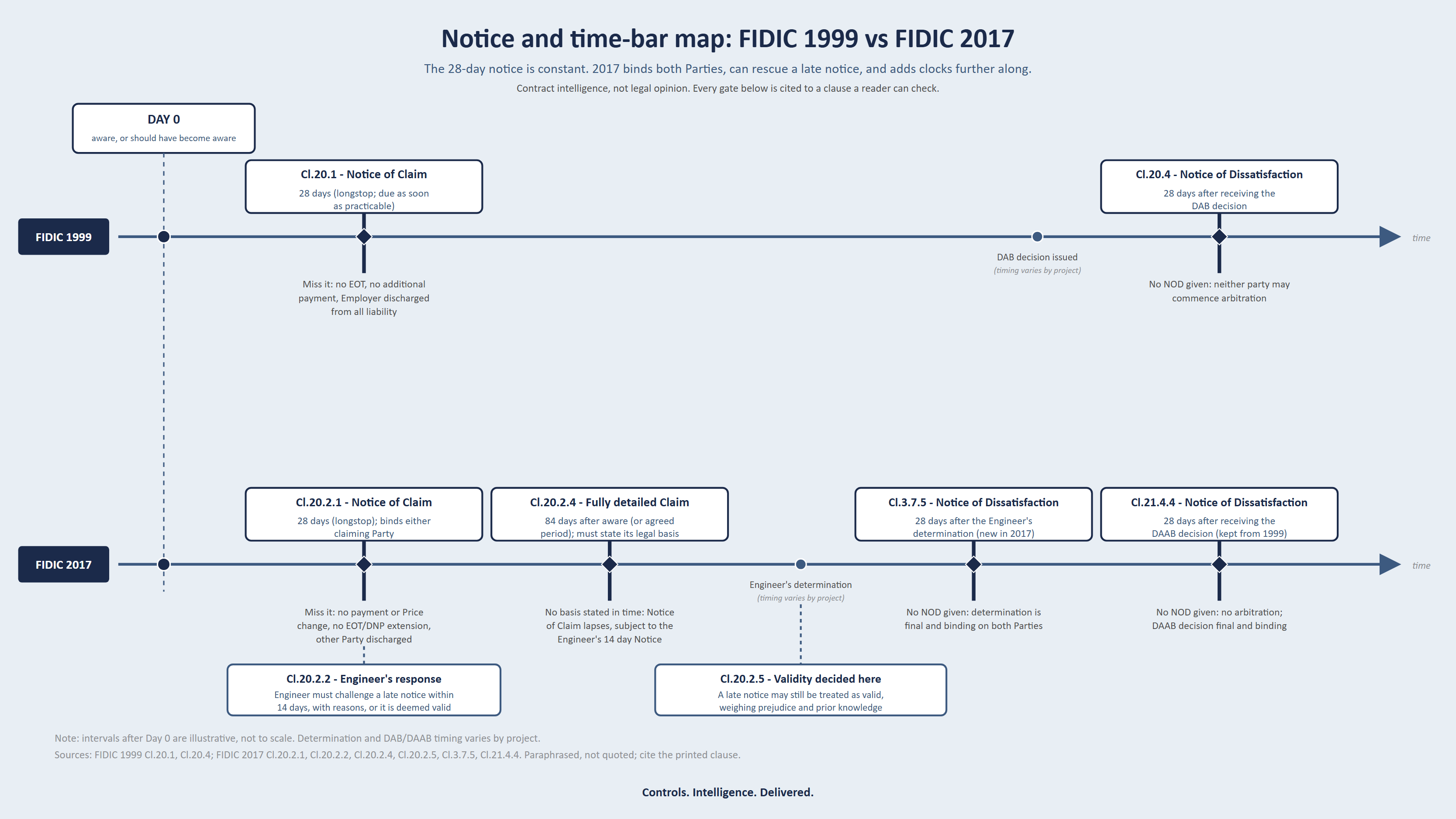
FIDIC 1999 Sub-Clause 20.1 requires the Contractor to notify the Engineer of an event or circumstance giving rise to a claim as soon as practicable, and no later than 28 days after the Contractor became aware, or should have become aware, of it. Miss that longstop and the consequence is not partial: no extension of Time for Completion, no additional payment, and the Employer discharged from all liability in connection with the claim, all three on the one 28-day trigger.
FIDIC 2017 Sub-Clause 20.2.1 carries the identical 28-day mechanic but restructures who it binds. The bar now runs against "the claiming Party", not the Contractor alone, so an Employer claim is caught by the same clock the Contractor has always faced. That reversal of a 1999-era habit is the most operationally useful fact in the comparison.
2017 also adds a genuine check on the Engineer. Under Sub-Clause 20.2.2, if the Engineer considers a Notice of Claim late, the Engineer must say so, with reasons, within 14 days of receiving it. Silence is not neutral: no response inside that window deems the Notice of Claim valid. Deemed validity is not the last word, though. Under Sub-Clause 20.2.5 the agreement or determination of the Claim decides whether a late Notice of Claim is treated as valid, taking account of any justification for the lateness, including prejudice to the other Party and what that Party already knew.
The Notice of Dissatisfaction is not a 2017 invention. It exists in FIDIC 1999 Sub-Clause 20.4, where either party has 28 days after receiving a DAB decision to give notice of dissatisfaction, failing which neither party may commence arbitration. FIDIC 2017 keeps that step at Sub-Clause 21.4.4, 28 days after the DAAB's decision. What 2017 adds is a second, earlier Notice of Dissatisfaction at Sub-Clause 3.7.5, against the Engineer's determination: 28 days to give it, failing which the determination becomes final and binding.
The point that matters for a team running a 2017 contract on 1999 instincts: the later edition is not simply harder or softer. It loosens the first fuse, because a late Notice of Claim can survive Engineer silence or be treated as valid in the determination. Then it adds fuses further along. Under Sub-Clause 20.2.4 a Notice of Claim lapses if the fully detailed Claim does not set out its contractual or other legal basis within 84 days, and under Sub-Clause 3.7.5 a determination nobody objects to within 28 days binds both Parties.
| Edition | Clause | Trigger | Period | Consequence |
|---|---|---|---|---|
| 1999 | Cl.20.1 | Contractor aware, or should have been aware, of the event | 28 days (longstop; notice due as soon as practicable) | No EOT, no additional payment, Employer discharged from liability |
| 2017 | Cl.20.2.1 | Claiming Party (Contractor or Employer) aware, or should have been aware, of the event | 28 days (longstop; notice due as soon as practicable) | No additional payment or Contract Price reduction, no EOT or DNP extension, other Party discharged from liability |
| 2017 | Cl.20.2.2 | Engineer disputes validity of a Notice of Claim | 14 days for the Engineer to respond, with reasons | No response within 14 days deems the Notice of Claim valid |
| 2017 | Cl.20.2.5 | Notice of Claim given late | Decided in the agreement or determination of the Claim | May be treated as valid, weighing any justification, prejudice to the other Party and its prior knowledge |
| 2017 | Cl.20.2.4 | Fully detailed Claim does not state its contractual or other legal basis | 84 days after awareness | Notice of Claim deemed lapsed, subject to Engineer challenge and the determination |
| 1999 | Cl.20.4 | Party dissatisfied with the DAB decision | 28 days | No entitlement to commence arbitration without a Notice of Dissatisfaction |
| 2017 | Cl.21.4.4 | Party dissatisfied with the DAAB decision | 28 days | No entitlement to commence arbitration without a Notice of Dissatisfaction |
| 2017 | Cl.3.7.5 | Party dissatisfied with the Engineer's determination | 28 days | Determination becomes final and binding if no Notice of Dissatisfaction is given |
Outcome
What this discipline produces is a named obligation, a named trigger date, a named clause, and an audit trail a reviewer can walk from the register entry back to the printed page. That is the deliverable, on a live engagement or on a standard-form comparison like this one. No client engagement is reported here; the example above runs on standard-form text alone.
What it demonstrates
Provenance beats speed. A notice and time-bar register only holds up if every line survives a reviewer opening the actual contract next to it, and that only holds if the register was built by tracing clauses rather than recalling them.
The scope boundary is explicit and does not move. ContractsIQ is contract intelligence, not legal opinion. Forseti will tell a reader that FIDIC 1999 Cl.20.1 bars a claim after 28 days and show exactly where that sits in the document. It will not tell a reader whether that bar is enforceable against them in a South African forum on their specific facts. That question goes to instructed attorneys, and the register is built to hand over cleanly when it does.